


You've probably heard that from the fall some ingredients will be banned, others strictly regulated, and that's where a lot of confusion has arisen. Everyone's heard about HEMA, HEMA free, TPO free , but few can make a clear distinction between HEMA, TPO and TPO-L.
In order to have a technical manicure product that polymerizes under the UV LED lamp, we need 3 types of ingredients:
1) monomers (liquid substances that have small molecules and adhere to the natural nail, help the adhesion of the layers underneath - for top coats);
2) photoinitiators (liquid or solid substances which, in the presence of UVA and blue radiation or 'light' from the lamp, break into pieces and bind to monomers, forming long polymer strands, resembling a fishing-net-like structure)
3) ingredients for structure and durability (oligomers and copolymers, more viscous substances or powders, which offer strength but also some flexibility; oligomers also have very good adhesion properties with nail plate and other manicure layers).
To all other classes of ingredients above add pigments (for special effects and coloring) and preservatives, to keep the product intact and prevent contamination with microorganisms or yellowing/discoloration of products.
HEMA: who is it, what does it do, is it banned or not?
HEMA (2-hydroxyethyl methacrylate) is a monomer with small molecule and short chainwhich makes it penetrates easily (superficially) into the prepared layer of the nail.
In general, almost all ingredients found in manicure products are oily ("greasy"), viscous and do not penetrate well into the nail. But HEMA, because it has the small molecule and this OH- group, like a "pigtail",
can penetrate well into the first blistered/pilled layers
of the human fingernail and interact with the fingernail and bind very well.

Also thanks to this "pigtail", HEMA is very liquid, transparent, slightly runny and combines very well with ... water. And when it accidentally ends up on human skin (which has a lot of water and fat in it), HEMA can reach deeper into the skin and irritate and cause allergies.
For this fact, European Union has decided that HEMA can only be bought and used by specialized people in specialized shops and carefully labeled, where the potential allergenic risk is indicated.
But HEMA is not forbidden!!!. And used correctly and in low concentrations in products, HEMA provides good adhesion and flow. The human nail has no immune system, so nail application only of HEMA products does not in itself lead to allergy.
TPO and TPO-L
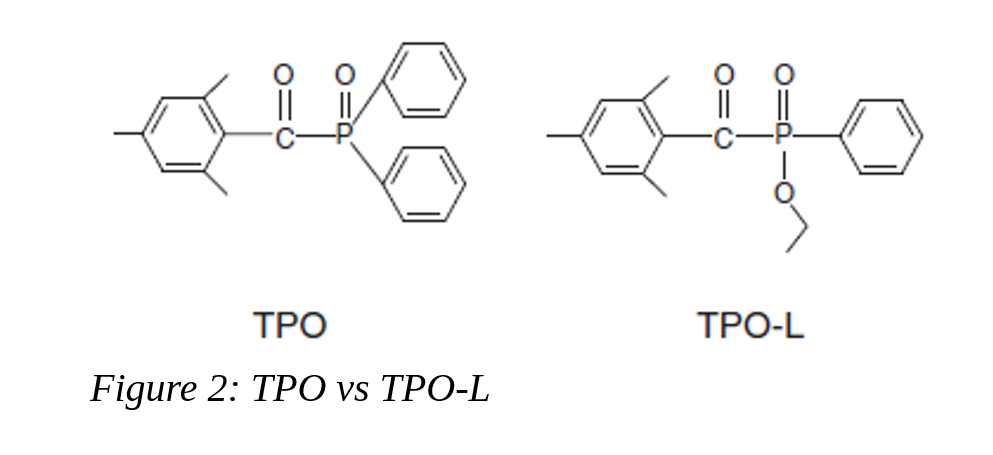
A big misunderstanding also arises between these 2 different substanceseven if they are from the same family. Think of TPO as 'big cousin' and TPO-L as 'little cousin'. Even though they are from the same family of ingredients (photoinitiators, which under UVA radiation "break" in 2 and bind to the other ingredients in the products), yet they are different.
TPO - in short
Diphenyl(2,4,6 trimethylbenzoyl) phosphine oxide: yellowish-white powder, waxy, used in gels to initiate polymerization. It also requires radiation UVA (365 nm), and visible radiation (405 nm) to be fully activated and create 2 radicals.
When the TPO molecules break into 2 radicals, they become completely transparent and that polymeric network is created - the construct itself or the base/top/core layer etc.
Because it is also used in other industries (packaging inks, industrial adhesives, etc.), where polymerization should be almost instantaneous and lamps are not rigorously changed as in salons, these packages that end up in the environment and come into contact with small living creatures can impact their reproduction.
Toxicology tests were done on small animals with twelve huge compared to those used in technical manicure. Here it is used in low concentrations, so that the polymerization proceeds in a controlled manner for 1-2 minutes, without releasing too much heat.
TPO-L
Ethyl(2,4,6 trimethylbenzoyl) phospinate - compared to TPO, TPO-L is liquid, incorporates much better into products, is more biodegradable and has potentially lower sensitization risks than TPO.
TPO-L retains the benefits of TPO (fast polymerization, in-depth efficiency, no excessive yellowing).Studies so far show that TPO-L is non-carcinogenic, does not affect reproduction and has a much better safety profile for use in cosmetics. Therefore, TPO-L is not banned by EU regulations - is allowed and considered a safe ingredient within the usual concentration limits in nail products (max 5%, usually 1-2%, low compared to other industries).
Mimona products contain TPO-L and have been reformulated to meet European standards a long time ago to get used to these changes.

Resources :
- https://cosmileeurope.eu/inci/detail/6327/hema/
- https://health.ec.europa.eu/publications/safety-cosmetic-ingredients-hema-and-di-hema-trimethylhexyl-dicarbamate-submission-i_en
- Angew. Chem. Int. Ed. 2025, e202425598 , doi.org/10.1002/anie.202425598
- Safety Assessment of Trimethylbenzoyl Diphenylphosphine Oxide as Used in Cosmetics , Cosmetic Ingredient Review March 2025: https://www.cir-safety.org/sites/default/files/Trimethylbenzoyl_Diphenylphosohine_Oxide.pdf
- Cytotoxicity, Color Stability and Dimensional Accuracy of 3D Printing Resin with Three Different Photoinitiators Gi-Tae Kim , Hye-Bin Go , Jae-Hun Yu , Song-Yi Yang , Kwang-Mahn Kim , Sung-Hwan Choi , and Jae-Sung Kwon
- Impact of light intensity on the polymerization kinetics and network structure of model hydrophobic and hydrophilic methacrylate based dental adhesive resin Farhana Abedin, Qiang Ye Kyle Camarda, Paulette Spencer
- https://www.industrialchemicals.gov.au/sites/default/files/Phosphine%20oxide%2C%20diphenyl%282%2C4%2C6-trimethylbenzoyl%29-_Human%20health%20tier%20II%20assessment.pdf
- UV-cured polymer aided polymer aided phase change thermal energy storage: Preparation, mechanism and prospects, Tong Xiao, Long Geng, Yucheng Dai, Jiateng Zha, Changhui Liu
Photoinitiators : Structures, Reactivity and Applications in Polymerization, Volume 1 ,Jean-Pierre Fouassier, Jacques Lalevée, ISBN-10 3527346090 , ch 3, pag : 68 - 76